

在SCI论文撰写中,讨论部分是连接研究结果与学术前沿的核心环节,既要客观解读数据,又要合理延伸研究价值。但很多科研人员会陷入一个误区:为了体现研究的探索性,频繁使用"maybe"(可能)、"we suppose"(我们推测)、"perhaps"(或许)等模糊词汇。这类表达看似谨慎,实则会削弱结论的可信度,让审稿人觉得研究证据不足、逻辑松散,甚至质疑研究的科学性。
事实上,科研结论的严谨性并非来自模糊的推测,而是源于"证据支撑+逻辑推导+合理限定"的表达体系。今天我们就从"为什么要避免模糊词汇""不同场景的替代表达策略""实操技巧与案例"三个维度,帮助大家在讨论部分既保持科学审慎,又彰显研究的说服力。
模糊词汇的潜在风险:
为何不能滥用"maybe"?
在学术写作中,"maybe""we suppose"等词汇的核心问题的是缺乏学术严谨性,具体体现在三个方面:
弱化证据与结论的关联性:SCI论文的结论必须建立在数据支撑之上。当使用"maybe"时,相当于默认"研究结果与结论之间存在不确定的鸿沟",审稿人会质疑:"如果只是'可能',为何不补充实验验证?"这种表达会让研究的科学性大打折扣。
体现逻辑推导的薄弱:讨论部分的核心是"分析结果→解释机制→关联文献"的逻辑链。模糊词汇往往是逻辑断裂的"遮羞布"——当科研人员无法通过数据和文献证明某个观点时,会用"maybe"掩盖逻辑漏洞,这恰恰是审稿人重点关注的问题。
降低论文的学术影响力:一篇有分量的SCI论文,需要在现有研究基础上提出明确的观点或新的认知。模糊的表达会让读者难以把握研究的核心贡献,甚至怀疑研究的创新性和实用性,影响论文的引用率和学术价值。
例如,有论文写道:"Maybe the increase in enzyme activity is related to the upregulation of gene X." 这句话既没有说明"酶活性升高"的具体数据支撑,也没有解释"基因X上调"与酶活性的关联机制,完全是主观推测,很容易被审稿人质疑"证据不足"。
不同场景的替代表达策略:
严谨且不失灵活
避免模糊词汇并非意味着要使用绝对化表达(如"prove""definitely""certainly",这类词汇同样不可取,因为科研结论往往具有相对性和局限性),而是要根据具体场景,选择"有依据、有逻辑、有限定"的表达。以下是讨论部分最常见的4种场景及对应的替代策略:
场景1:基于研究结果的合理推测
(有数据支撑,但需进一步验证)
当研究结果显示某种趋势或关联,但尚未通过多方面实验(如体外验证、动物实验、临床样本验证)完全证实时,不能用"maybe",而应明确"推测的依据"和"推测的限定范围"。
替代表达框架:
基于数据趋势:"The observed [结果,如increased expression of protein A] suggests that [推测,如protein A may play a role in cell proliferation],as supported by the positive correlation between [指标1] and [指标2] (r=0.78, P<0.01)."
结合机制推导:"The enhanced catalytic efficiency could be attributed to [推测机制,如the conformational change of the active site],given that [数据依据,如the mutation at position 123 altered the binding affinity of the substrate (Table 3)]."
错误示例:"Maybe the higher survival rate in the treatment group is due to the anti-inflammatory effect of drug X."
修正示例:"The significantly higher survival rate in the treatment group (68% vs. 32%, P<0.001) may be attributed to the anti-inflammatory effect of drug X,as evidenced by the reduced levels of pro-inflammatory cytokines (TNF-α, IL-6) in the serum of treated mice (Fig. 4)."
场景2:解释研究结果与文献的差异
(存在矛盾,需客观分析)
当研究结果与现有文献不一致时,不能用"we suppose"模糊带过,而应深入分析差异的可能原因(如实验设计、样本类型、研究对象、技术方法等),体现研究的客观性。
替代表达框架:
归因于实验设计:"Our findings differ from those reported by Smith et al. (2022),which may be explained by the difference in [实验变量,如cell lines used: we employed primary hepatocytes whereas they used HepG2 cells]."
考虑研究局限性:"The discrepancy between our results and previous studies could be due to [局限性,如the small sample size in our study (n=30) compared to the large cohort (n=200) in Lee et al.'s research]."
提出新的可能性:"This inconsistent observation might reflect [新视角,如a context-dependent role of gene Y,which is upregulated in early-stage tumors but downregulated in advanced stages],a hypothesis that requires further investigation."
错误示例:"We suppose the different results are because of different experimental conditions."
修正示例:"The divergent results between our study and the work of Zhang et al. (2023) could be explained by the distinct experimental conditions: we used a dose of 10 μM for compound Z and incubated for 24 h,whereas they applied 50 μM and a 48-h incubation period,which may have led to off-target effects (Supplementary Table 2)."
场景3:阐述研究的局限性
(客观承认,而非模糊回避)
所有研究都存在局限性(如样本量小、随访时间短、技术方法的缺陷等),讨论部分需要客观说明,但不能用"maybe"来淡化局限性,而应明确"局限性是什么"以及"如何影响研究结论"。
替代表达框架:
明确局限性:"One limitation of this study is [具体局限,如the lack of long-term follow-up data (median follow-up: 12 months)],which prevents us from evaluating the long-term efficacy of the treatment."
说明对结论的影响:"The use of [技术方法,如qPCR] for gene expression analysis may have introduced potential bias,as this method is less sensitive than RNA-seq in detecting low-abundance transcripts."
提出改进方向:"Future studies should address this limitation by [改进措施,如increasing the sample size and including a more diverse population] to validate our findings."
错误示例:"Maybe the small sample size affects the reliability of the results."
修正示例:"The relatively small sample size (n=25) in the control group may limit the generalizability of our conclusions,as the statistical power to detect subtle differences between groups was reduced (power analysis: 0.72 for α=0.05)."
场景4:提出未来研究方向
(基于现有结果,而非无依据的猜想)
讨论部分的未来方向需要紧扣研究结果和学术前沿,不能用"maybe we can study..."这种模糊表达,而应明确"研究的具体内容"和"研究的意义"。
替代表达框架:
基于现有结果延伸:"Given that [现有结果,如inhibition of protein B reduced tumor growth in vitro],future studies could focus on [具体方向,如developing small-molecule inhibitors of protein B for clinical trials]."
针对未解决的问题:"The mechanism underlying [未解决的问题,如the cross-talk between pathway A and pathway B] remains unclear,and further investigations using [技术方法,如co-immunoprecipitation and mass spectrometry] are warranted to clarify this interaction."
错误示例:"Maybe we can study the mechanism of gene X in other diseases."
修正示例:"Given that gene X was found to be dysregulated in both breast cancer (our study) and lung cancer (Wang et al., 2024),future research could explore the role of gene X in other epithelial malignancies,which may provide insights into the shared pathogenic mechanisms of these cancers."
实操技巧:让讨论部分既严谨又有说服力
除了替换模糊词汇,还可以通过以下3个技巧进一步提升讨论部分的学术严谨性:
技巧1:用"证据链"支撑每一个观点
讨论部分的每一个推测或结论,都必须有"数据+文献"的双重支撑。例如,在提出某个机制时,不仅要引用本研究的实验数据(如Western blot结果、统计分析),还要引用相关文献的研究结果,形成完整的证据链。
示例:"Our data showed that overexpression of miR-124 significantly inhibited cell migration (Fig. 5A, P<0.01),which is consistent with the findings of Liu et al. (2023) who reported that miR-124 targets the oncogene MET. This suggests that miR-124 may suppress tumor metastasis by downregulating MET expression,as MET has been shown to promote cell migration and invasion in multiple cancer types (Zhang et al., 2022; Li et al., 2023)."
技巧2:使用"限定词"替代模糊词汇
除了前面提到的"may be attributed to""could be explained by",还可以使用以下限定词,既避免绝对化,又体现科学审慎:
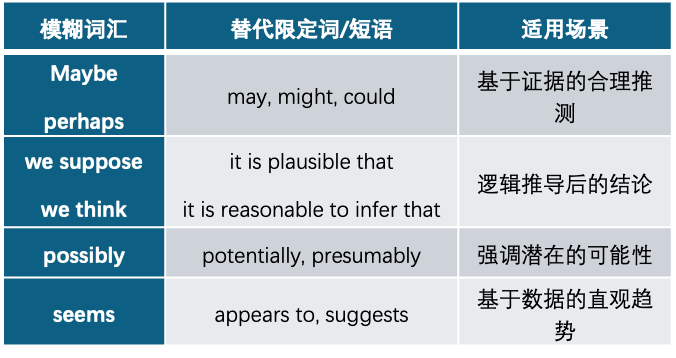
注意:使用这些限定词时,必须搭配具体的证据或逻辑推导,不能单独使用。例如,"it is plausible that"后面必须紧跟"为什么合理"的理由,而不是孤立的推测。
技巧3:避免过度绝对化,保持科学谦逊
虽然要避免模糊词汇,但也不能走向另一个极端——使用绝对化表达。以下绝对化词汇同样需要慎用:
完全否定:never, none, no effect
完全肯定:prove, confirm, definitely, certainly
全面概括:all, every, all cases
示例:
错误:"This study proves that drug X is effective in treating diabetes."
修正:"This study demonstrates that drug X exhibits significant hypoglycemic effects in a mouse model of type 2 diabetes (Fig. 3),supporting its potential as a therapeutic agent for this disease."
讨论部分的核心原则:"有理有据,进退有度"
SCI论文讨论部分的写作,本质上是一场"基于证据的学术对话"。避免使用"maybe""we suppose"等模糊词汇,核心是要做到:
有据可依:每一个观点都必须有本研究数据或相关文献的支撑,不做无依据的推测;
有逻辑可循:从结果到结论的推导过程要清晰,用"because""as""given that"等逻辑连接词体现因果关系;
有限定范围:用"may""could""potentially"等限定词明确结论的适用场景,既不夸大也不模糊;
有客观态度:正视研究的局限性,不回避矛盾,用理性分析替代主观臆断。
审稿人关注的不是研究是否"完美无缺",而是科研人员是否具备"科学思维"——能否客观解读数据、严谨推导结论、理性看待局限。告别"maybe",用"证据+逻辑+限定"的表达体系,让讨论部分真正成为展现研究价值和学术素养的核心载体,助力论文顺利发表!